
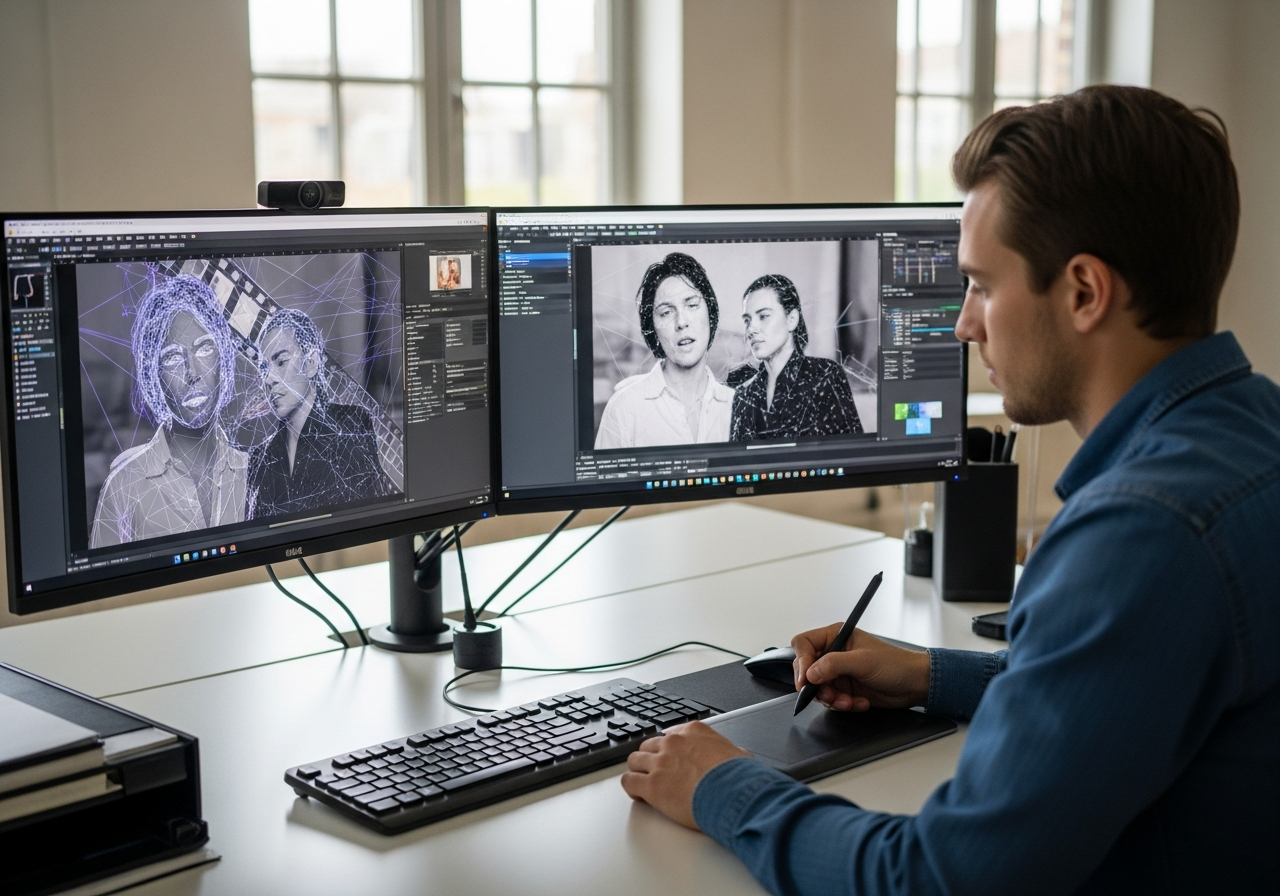
What Employers Look for in a Junior Roto and Prep Artist
The Canadian VFX industry defines junior roto and prep artist roles with specific expectations that blend technical precision with pipeline efficiency. In the Canadian hiring landscape, these positions encompass junior roto specialists focused on matte creation, junior prep artists handling plate cleanup, and increasingly common hybrid roles that combine both skill sets. Understanding these distinctions is crucial for job seekers targeting Canada’s competitive visual effects market.
What makes Canadian employers’ screening process unique is their emphasis on practical employability over artistic flair. Studios across Canada, from Vancouver’s major facilities to Toronto’s boutique houses, consistently prioritize candidates who demonstrate clean technical execution, reliable workflow integration, and the ability to handle notes and revisions efficiently. This approach reflects the industry’s need for junior artists who can immediately contribute to production pipelines without requiring extensive retraining or causing downstream complications for compositing teams.
How Canadian Studios Define the Junior Roto and Prep Role
Canadian VFX studios structure junior roto and prep positions to support their compositing pipelines while accommodating varying project demands. The role definitions have evolved to reflect both specialized skill requirements and the practical need for versatile team members who can adapt to different shot types and production schedules.
The distinction between roto, prep, and hybrid postings reflects how Canadian studios organize their workflows. Pure roto positions focus exclusively on creating clean mattes and isolating elements, while dedicated prep roles handle plate cleanup, stabilization, and shot preparation. However, many Canadian employers now prefer hybrid candidates who can seamlessly transition between both responsibilities.
These roles serve as the foundation for compositing pipelines, ensuring that shots reach senior artists in a ready-to-composite state. Junior artists in these positions directly impact production efficiency and shot quality, making their technical accuracy and pipeline awareness critical to studio operations.
| Role area | Junior roto focus | Junior prep focus | Employer expectation |
|---|---|---|---|
| Matte creation | Primary responsibility | Secondary skill | Clean, precise shapes with proper edge control |
| Plate cleanup | Basic removal work | Advanced cleanup and repair | Seamless integration without visible artifacts |
| Tracking and stabilization | Shape tracking for mattes | Camera and object tracking | Stable, accurate tracks that hold throughout shots |
| Pipeline integration | Matte delivery and naming | Prepared plates for compositing | Consistent workflow and file organization |
| Quality control | Matte accuracy and consistency | Cleanup quality and grain matching | Self-review before submission to leads |
Roto vs. Prep vs. Roto/Prep Hybrid
Rotoscoping in the Canadian context specifically refers to creating mattes that isolate elements within shots, allowing compositors to selectively apply effects or integrate new elements. This involves drawing and animating precise shapes around objects, characters, or areas that need to be separated from their backgrounds. The quality of these mattes directly impacts the final composite quality, making edge control and temporal consistency critical skills.
Prep work encompasses plate cleanup, stabilization, and shot preparation tasks that ready footage for compositing. This includes removing unwanted objects, fixing technical issues, matching grain structure, and ensuring plates are properly formatted and organized. Prep artists also handle degrain and regrain workflows, maintaining the original footage’s visual characteristics while enabling clean compositing work.
Hybrid roto/prep positions have become increasingly common in Canadian studios because they offer greater staffing flexibility and provide junior artists with broader skill development. These roles require candidates who can seamlessly switch between creating mattes and cleaning plates depending on shot requirements and project demands.
Where the Role Sits in the Pipeline
Junior roto and prep artists occupy a crucial position between initial shot intake and final compositing. They receive shots from editorial or data wranglers and prepare them for senior compositors, leads, and supervisors. This positioning requires understanding both upstream requirements (what needs to be delivered) and downstream expectations (how compositors will use the prepared materials).
The feedback loop is equally important, as junior artists regularly receive notes from leads and supervisors requiring revisions to mattes or cleanup work. Success in this role depends on responding efficiently to these notes while maintaining shot consistency and meeting delivery deadlines.
Technical Skills Canadian Employers Expect First
Canadian employers prioritize fundamental technical competencies that demonstrate a candidate’s ability to produce clean, consistent work within production deadlines. These skills form the foundation of successful junior roto and prep work, with employers valuing precision and efficiency over complex artistic techniques.
The emphasis on core technical skills reflects the reality of production work, where junior artists must handle high shot volumes while maintaining quality standards. Canadian studios particularly value candidates who can demonstrate these skills consistently across different shot types and complexity levels.
Software proficiency extends beyond basic tool knowledge to include understanding how these tools integrate with studio pipelines and production workflows. Employers look for evidence that candidates can adapt their technical skills to studio-specific requirements and maintain consistency with established workflows.
Clean, efficient work consistently outperforms flashy complexity in Canadian hiring decisions. Studios need junior artists who can deliver reliable results on schedule, rather than candidates who create impressive but impractical workflows.
- Precise shape creation and edge control for clean matte boundaries
- Temporal consistency in animated mattes across shot duration
- Tracking proficiency for both simple and complex camera movements
- Plate cleanup techniques including seamless object removal
- Degrain and regrain workflows for maintaining visual consistency
- File organization and naming conventions for pipeline integration
- Quality control processes and self-review practices
Core Technical Competencies
The foundation of junior roto and prep work lies in executing fundamental techniques with precision and consistency. Canadian employers specifically look for candidates who can create clean shapes with proper edge control, understanding that these skills directly impact final shot quality and compositing efficiency.
Tracking accuracy represents another critical competency, as unstable or inaccurate tracks create significant problems downstream. Employers value candidates who can assess tracking challenges and apply appropriate solutions, whether through manual refinement or alternative approaches.
Shot consistency across sequences requires technical discipline and attention to detail. Canadian studios particularly appreciate junior artists who can maintain visual and technical standards across multiple shots, ensuring that individual work integrates seamlessly into larger sequences.
Software and Pipeline Knowledge That Improves Hireability
Canadian VFX studios operate with established software toolsets and pipeline workflows that require specific knowledge and adaptation skills. Understanding these technical requirements and demonstrating relevant experience significantly improves a candidate’s prospects during the hiring process.
Pipeline knowledge often weighs equally with software skills in Canadian hiring decisions. Studios value candidates who understand how their individual work integrates with larger production workflows and can adapt to studio-specific requirements without extensive retraining.
The ability to work efficiently within established systems demonstrates professional readiness and reduces onboarding time. Canadian employers particularly value candidates who can quickly integrate into existing workflows while maintaining quality and productivity standards.
| Tool | Why employers value it | Typical junior use |
|---|---|---|
| Nuke | Industry standard compositing platform | Roto node, tracking, basic cleanup operations |
| Silhouette | Specialized roto and paint workflow efficiency | Complex matte creation and detailed cleanup work |
| Photoshop | Essential for texture work and plate preparation | Reference creation, texture patches, simple cleanup |
| Shotgun/Ftrack | Production tracking and review workflows | Shot status updates, note management, version control |
| RV/Screening tools | Quality control and review processes | Self-review, comparison workflows, dailies preparation |
Common Tools in Junior Roto/Prep Hiring
Nuke proficiency represents the most critical software requirement for Canadian junior positions, as it serves as the primary compositing platform across most studios. Employers expect candidates to understand Nuke’s roto node, basic tracking capabilities, and file handling workflows, even for roles that may primarily use other specialized tools.
Silhouette knowledge significantly enhances hireability for roto-focused positions, as many Canadian studios have adopted it for complex matte creation workflows. Understanding both Nuke and Silhouette integration demonstrates pipeline awareness and workflow flexibility that employers highly value.
Pipeline Awareness and Review Readiness
Understanding production databases and review systems shows employers that candidates can integrate into existing workflows without extensive training. Canadian studios particularly value junior artists who can manage shot assignments, respond to notes efficiently, and maintain accurate status updates throughout the production process.
Quality control awareness and self-review practices demonstrate professional maturity and help avoid additional work downstream. Employers look for candidates who can identify and resolve issues before submission, reducing review cycles and maintaining production efficiency.
Soft Skills Employers Screen for in Junior Candidates
Canadian VFX studios prioritize soft skills that indicate a candidate’s ability to work effectively within team environments and handle the demands of production schedules. These behavioral traits often determine long-term success more than raw technical ability, as studios invest in junior artists who can grow and contribute consistently to team dynamics.
The emphasis on reliability and team fit reflects the collaborative nature of VFX production, where individual work directly impacts other team members and project timelines. Canadian employers particularly value candidates who demonstrate these qualities consistently across different work situations.
Professional communication and responsiveness to feedback represent crucial skills for junior positions, as these roles involve regular interaction with leads, supervisors, and other team members. The ability to handle notes gracefully and implement changes efficiently directly impacts both individual success and team productivity.
- Attention to detail and consistency across multiple shots and sequences
- Professional communication and responsiveness to feedback and direction
- Deadline management and realistic time estimation for assigned tasks
- Initiative in problem-solving and seeking help when needed
- Patience and persistence when working on complex or repetitive tasks
- Collaborative attitude and willingness to support team goals over individual recognition
Most Valued Workplace Behaviours
Canadian studios consistently value collaborative attitudes and professional responsiveness above individual artistic ambition in junior hires. The ability to work effectively within established team structures, accept direction gracefully, and contribute positively to group dynamics often determines long-term career success within the Canadian VFX industry.
Initiative balanced with appropriate help-seeking demonstrates the professional maturity that employers look for in junior candidates. Studios appreciate artists who can work independently when appropriate while recognizing when to seek guidance or clarification to avoid costly mistakes or delays.
What Canadian Employers Want to See in a Junior Reel
Canadian employers approach junior reel evaluation with specific criteria that prioritize technical competency and clear communication over artistic complexity. The most successful reels demonstrate fundamental skills through carefully selected examples that show consistent quality and understanding of professional standards.
Reel expectations in Canada emphasize shot selection that clearly shows the candidate’s individual contribution and technical capabilities. Studios prefer concise presentations that allow quick assessment of relevant skills rather than longer reels that may dilute the impact of strong work with weaker examples.
Simple, clear examples consistently outperform longer, unfocused reels in Canadian hiring decisions. Employers typically spend limited time reviewing each submission, making clarity and immediate impact crucial for advancing to interview stages.
The evaluation process focuses on technical execution, consistency, and evidence of pipeline awareness rather than creative innovation or complex artistic choices. This practical approach reflects the reality of junior roles within production environments.
| Reel element | Strong signal | Weak signal | Why it matters |
|---|---|---|---|
| Matte edges | Clean, properly feathered transitions | Hard or inconsistent edge quality | Demonstrates fundamental technical competency |
| Shot consistency | Uniform quality across sequence | Variable quality between shots | Shows ability to maintain standards under production pressure |
| Tracking accuracy | Stable, accurate motion following | Sliding or unstable track points | Critical for all subsequent compositing work |
| Cleanup integration | Seamless, undetectable repairs | Visible artifacts or grain mismatches | Indicates understanding of photographic principles |
| Reel length | 60-90 seconds of focused content | Over 2 minutes or unfocused material | Respects reviewer time and attention |
| Contribution clarity | Clear before/after or breakdown showing | Unclear what candidate actually contributed | Enables accurate skill assessment |
Reel Content That Helps Juniors Get Interviews
Effective junior reels focus on edge quality and matte accuracy rather than complex artistic choices. Canadian employers specifically look for examples that demonstrate clean, well-controlled edges with appropriate feathering and consistent temporal behavior throughout shot duration.
Cleanup examples should showcase seamless integration and proper grain matching, indicating understanding of photographic principles and attention to visual consistency. The most impressive cleanup work appears completely natural and undetectable, requiring viewers to rely on before/after comparisons to appreciate the technical skill involved.
Clear presentation of individual contributions helps employers assess relevant skills accurately. This includes showing original footage alongside final results, highlighting specific areas of work, and providing brief explanations of the techniques used and challenges overcome.
Reel Mistakes That Hurt Junior Applicants
Overlength reels consistently hurt junior applications by diluting strong work with weaker examples and testing reviewer patience. Canadian employers typically allocate limited time for each reel review, making concise presentation crucial for maintaining engagement and impact.
Unclear contributions or mixed collaborative work makes skill assessment difficult and raises questions about the candidate’s actual capabilities. Including work where individual contributions cannot be clearly identified undermines the reel’s effectiveness as a hiring tool.
Canadian Hiring Signals Beyond Skills
Canadian VFX hiring involves practical considerations beyond technical competency that significantly impact employment prospects. These factors reflect the realities of operating within Canadian labor markets and the specific needs of studios working on international productions.
Location, work authorization, and contract flexibility often serve as initial screening criteria that determine whether candidates advance to technical evaluation stages. Understanding these practical requirements helps applicants position themselves appropriately within the Canadian market.
Studios balance specialized expertise against versatility needs based on their project mix and team structure. This balance varies between large facilities with specialized departments and smaller studios requiring more generalist capabilities.
- Legal authorization to work in Canada or appropriate visa status
- Geographic flexibility for major VFX centers (Vancouver, Toronto, Montreal)
- Contract work readiness and understanding of project-based employment
- Willingness to work across roto and prep disciplines as needed
- Understanding of Canadian production schedules and overtime expectations
- Adaptability to different studio sizes and workflow requirements
Practical Hiring Filters in Canada
Work authorization represents the primary practical filter in Canadian VFX hiring, as studios must navigate complex visa and permit requirements for international candidates. Understanding available work permit options and processing timelines helps candidates plan their applications and manage expectations appropriately.
Remote work policies vary significantly between Canadian studios, with some embracing flexible arrangements while others maintain traditional on-site requirements. Contract employment dominates the junior market, requiring candidates to understand project-based work cycles and plan for periods between contracts.
How Junior Applicants Can Position Themselves for Canadian Studios
Strategic positioning for Canadian VFX opportunities requires understanding both technical requirements and market realities. Successful candidates combine relevant skill development with practical preparation for the Canadian employment landscape and industry-specific application processes.
Portfolio building and application strategies should reflect Canadian market preferences while highlighting relevant experience and adaptability. This includes tailoring presentations for different studio sizes and project types while maintaining consistent technical standards.
Interview and test preparation requires understanding Canadian studio expectations and demonstrating readiness for production workflows. The most successful candidates show both technical competency and professional maturity through their preparation and presentation.
| Action | Why it helps | Best stage |
|---|---|---|
| Research studio-specific workflows | Demonstrates preparation and genuine interest | Before application submission |
| Create Canadian-focused reel versions | Aligns with local market expectations | Portfolio development phase |
| Understand work permit requirements | Avoids disqualification due to authorization issues | Early career planning |
| Practice pipeline terminology | Shows industry knowledge and communication skills | Interview preparation |
| Prepare for test tasks | Demonstrates real-world problem-solving ability | Active application process |
Portfolio and Application Strategy
Tailoring reels and CVs for Canadian markets involves understanding local industry terminology, software preferences, and presentation standards. This includes emphasizing relevant experience with Canadian-standard tools and workflows while clearly communicating work authorization status and availability.
Application materials should reflect awareness of Canadian production styles and technical requirements while maintaining focus on fundamental skills that transfer across projects and studios. Clear communication of individual contributions and technical approaches helps employers assess fit within their specific workflows.
Interview and Test-Task Preparation
Successful interview preparation involves practicing discussion of technical choices, workflow approaches, and problem-solving strategies. Canadian employers particularly value candidates who can articulate their thinking process and demonstrate flexibility in approach while maintaining quality standards.
Test task preparation should focus on demonstrating efficiency, accuracy, and note responsiveness rather than attempting complex artistic solutions. The ability to handle feedback gracefully and implement changes quickly often weighs more heavily than initial technical perfection in evaluation.
What Canadian Employers Look for Most Overall
Canadian VFX employers prioritize a balanced combination of technical accuracy, professional reliability, and team compatibility when hiring junior roto and prep artists. This synthesis reflects the industry’s need for artists who can contribute immediately to production workflows while developing their skills within established team structures.
The hiring criteria emphasize practical readiness over theoretical knowledge, with employers seeking candidates who demonstrate consistent execution of fundamental skills rather than ambitious attempts at complex techniques. This approach ensures that junior hires can handle production demands while growing into more advanced roles.
Technical accuracy forms the foundation of successful candidates, but professional maturity and team fit ultimately determine long-term success within Canadian studios. The most successful junior artists combine solid technical skills with collaborative attitudes and responsive communication.
Top Hiring Priorities in Order
Clean, consistent technical work ranks as the primary hiring criterion, followed closely by demonstrated ability to work effectively within team environments and respond appropriately to feedback and direction. Speed and efficiency matter, but accuracy and reliability take precedence in Canadian hiring decisions.
Professional communication skills and cultural fit within studio environments often serve as determining factors when candidates have similar technical capabilities. The ability to contribute positively to team dynamics while maintaining individual productivity standards represents the ideal combination that Canadian employers seek in junior hires.